
The mathematician Levent Alpöge has enjoyed a recent streak of settling major unsolved mathematical problems, including disproving the Jacobian conjecture in dimension ≥ 3 and demonstrating the existence of a complex structure on the 6-sphere. He also collaboratively with Ava Howell discovered elliptic curves of ranks 30 and 31, breaking the previous record of 29, though this was soon subsequently superseded by a rank-32 curve by Elkies, Klagsbrun, and Li.
Last week Alpöge released a Lean-verified proof of the Generalised Riemann Hypothesis for Dirichlet L-functions. This was hitherto heralded as one of the most (if not the most) important unsolved problems in mathematics, with a considerable body of published results being conditional on the assumption of GRH.
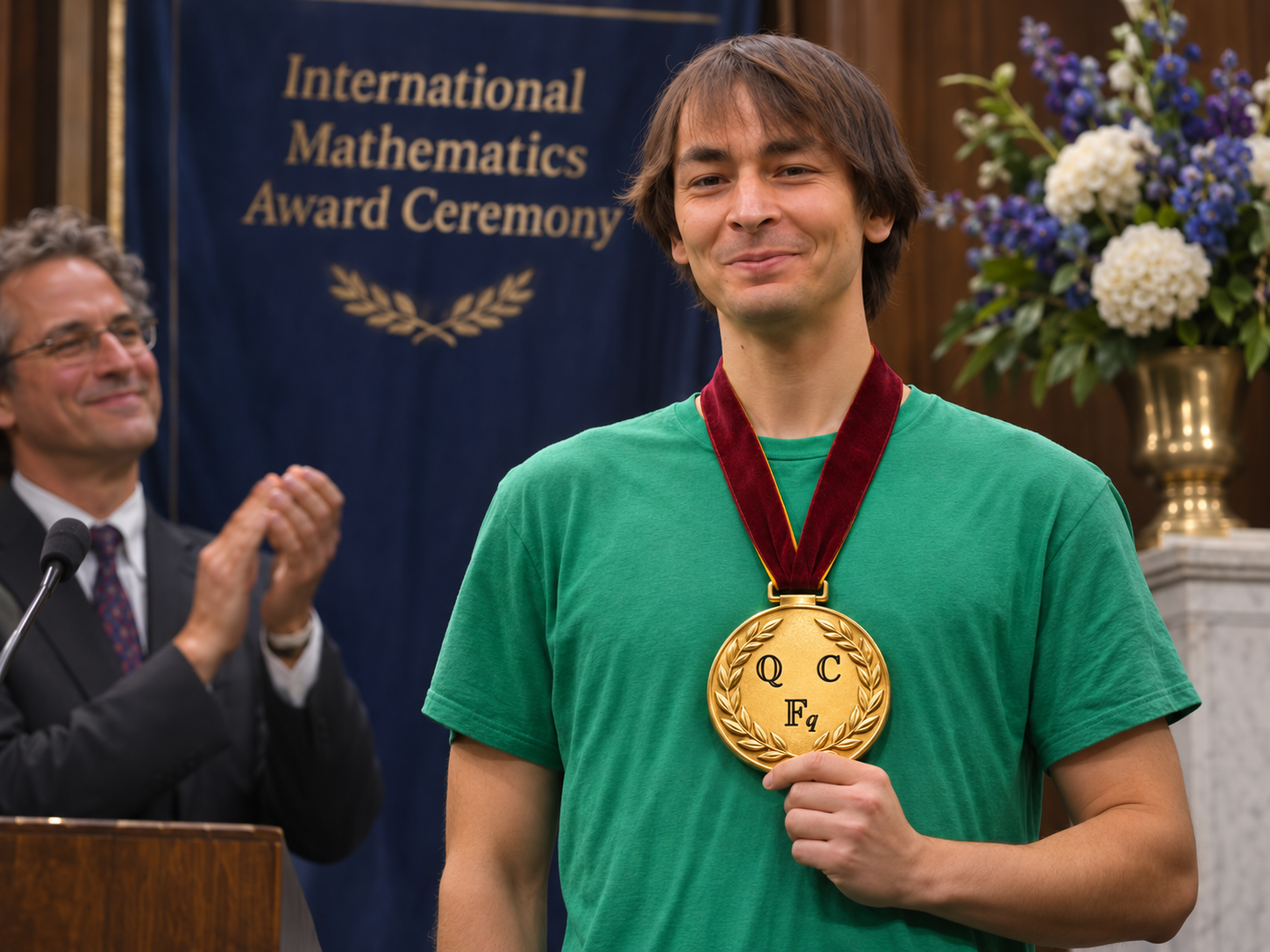
It would be a travesty for Alpöge to not receive a Fields Medal (as depicted above) for this work. There are two common objections that I’ve seen, both of which I consider to be misguided:
- Misconception I: “Claude did all of the work”
- Misconception II: “a 17M-line Lean proof doesn’t advance mathematics”
On the use of AI
The first misconception is straightforward to dismiss with the following argument: many other researchers have access to the same models as does Alpöge, and it is common to use famous unsolved problems as benchmarks for testing the capabilities of new models. If Claude were capable of discovering these results entirely by itself, we would expect to see completely random researchers unveiling the results, rather than a particular mathematician with notable research predating the invention of the Transformer.
Moreover, when results are developed entirely by an AI system acting in isolation without human guidance, such as the hundreds of results released by OpenAI (including the Navier-Stokes solution), the results are credited to the model rather than to an individual.
Yes, it is certainly the case that Alpöge made significant use of Claude as a tool, as he explained in his remark, but to deny the human element is folly. In terms of the three settled Millennium problems, we have the following trichotomy where rather amusingly the solved problems exactly biject with the nonempty subsets of {AI, human} according to the solver:
- Poincaré conjecture: entirely human
- Navier-Stokes existence and smoothness: entirely AI
- Riemann hypothesis: human + AI
(This is true at the time of writing, though I expect other Millennium problems to fall in the coming months.)
The human + AI combination is often termed a ‘centaur’, and in chess we saw a progression through three different phases as AI capabilities improved. In the beginning, machines were too weak to offer any assistance to the best chess players. This was followed by an interstitial period in which centaurs were better than humans or AI acting in isolation. Nowadays, engines such as Stockfish are so much more advanced than the best human grandmasters that a centaur has no advantage over a computer.
We are now seeing the second (centaur-dominated) phase play out in mathematics, and a golden age of interplay between human efforts and AI results. One example is how Will Sawin simplified the proof and strengthened the result following OpenAI’s original disproof of the unit-distance conjecture. A second example is Ben Green’s considerable simplification of OpenAI’s proof of the nonexistence of Landau-Siegel zeros.
On extremely long proofs
This lets one quite directly segue into debunking the second misconception, that a 17M-line proof of a result that people already generally believed to be true has no value. The two examples that I just gave are strong evidence against this: once you have one proof as a starting point, one can refine and simplify it and try to understand its mechanism, extracting ideas and abstractions that could be applied to other problems.
Also, whilst the proof is 17M lines of Lean, the way in which it was constructed (see the chronology in Alpöge’s remark) means that it isn’t anything like the worst-case scenario of a completely alien proof with no discernible structure: it was something arrived at by a combination of human guidance together with many technical details developed by a statistical model trained on (inter alia) mathematical reasoning.
Much of the reason for its length is that it includes proofs of transitive dependencies so as to be self-contained, and given the amount of machinery that it uses, such length is inevitable. Anthropic’s Lean formalisation of Wiles’s FLT proof is 13M lines of Lean code, yet Wiles’s proof itself is comprehensible; the amount of Lean is largely just formalising all of the prerequisites.
If, however, it isn’t possible to simplify the GRH proof to within the limits of human comprehensibility, this would be even more interesting.
Doron Zeilberger has an Opinion (to which I have recently warmed!) where he classifies provable statements as ‘shallow’ (if they can be done without computers) or ‘deep’ (otherwise). He gave the Four Colour Theorem as a candidate ‘deep’ statement, but it’s somewhat unsatisfying because the computer involvement was only in the form of a large case-bash. The Riemann Hypothesis is a vastly more interesting candidate for a ‘deep’ theorem, in that the computer involvement is extremely nontrivial and Levent’s proof contains swathes of technical details making use of machinery from many disparate areas of mathematics.
On the title of the article
This was, of course, puckishly provocative. If you took away the ability to use large language models, then Levent’s output — whilst impressive compared to the standards of most professional mathematicians — is not in the league of Hilbert or Shafarevich or Tao.
Ultimately, though, I claim that this doesn’t matter: mathematics is a scientific endeavour, not a game or sport or competition designed to test raw cognitive firepower. The use of certain tools — whether they be LLMs, or computers in general, or just lemmata cited from other papers — does not diminish the accomplishment of making a significant advancement to human knowledge.
The fact that more difficult problems are being solved than ever before is exciting, and I’m grateful to be alive whilst this happens…