The Monster group is very large, very complicated, and very mysterious.
According to the Classification of Finite Simple Groups that was completed last century, the Monster group is the largest of only 26 finite simple groups that do not fit into one of the infinite families of finite simple groups, namely:
- the cyclic groups of prime order;
- the alternating groups on 5 or more objects;
- any of the ‘groups of Lie type‘, which are related to Lie groups but defined over finite fields.
The existence of the Monster was conjectured by Bernd Fischer and later constructed by Robert Griess. This construction was subsequently simplified by John Conway, but the resulting construction is still very complicated and somewhat piecemeal. Both constructions prove that the group is finite by showing that it’s the automorphism group of the Griess algebra defined on the ambient vector space.
Let’s look at the group A5, the smallest of the non-cyclic finite simple groups, by way of analogy. It’s the order-60 group of rotational symmetries of a regular dodecahedron, and this is the lowest-dimensional faithful representation of the group:
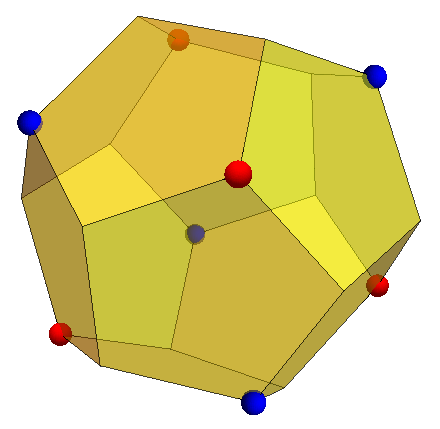
If we choose a coordinate basis for the dodecahedron such that the eight brightly-coloured vertices are (±1, ±1, ±1) and the remaining twelve vertices are the cyclic permutations of (±φ, ±1/φ, 0), then there’s a natural order-12 subgroup generated by cyclic permutations of the vertices together with an even number of sign flips.
This monomial subgroup is also a maximal subgroup, and happens to be the group A4 of rotations fixing a regular tetrahedron, such as the convex hull of the four blue vertices above. We can then describe A5 as being generated from this monomial subgroup together with an ‘exotic element’ ζ that sends:
- (1, -1, -1) → (0, φ, -1/φ);
- (-1, 1, -1) → (φ, -1/φ, 0);
- (-1, -1, 1) → (-1/φ, 0, φ);
- (1, 1, 1) → (-1, -1, -1).
We could also define A5 as the group of rotations which fix the following degree-6 polynomial (x − φy)(y − φz)(z − φx)(x + φy)(y + φz)(z + φx), which is isomorphic to Greg Egan’s potential function discussed here. This is mildly (but not precisely*) analogous to the description of the Monster as the automorphisms of the Griess algebra. Note that the polynomial is clearly invariant under the monomial subgroup A4, and with some effort can be shown to be invariant under the full group A5. Here’s a visualisation of the polynomial:
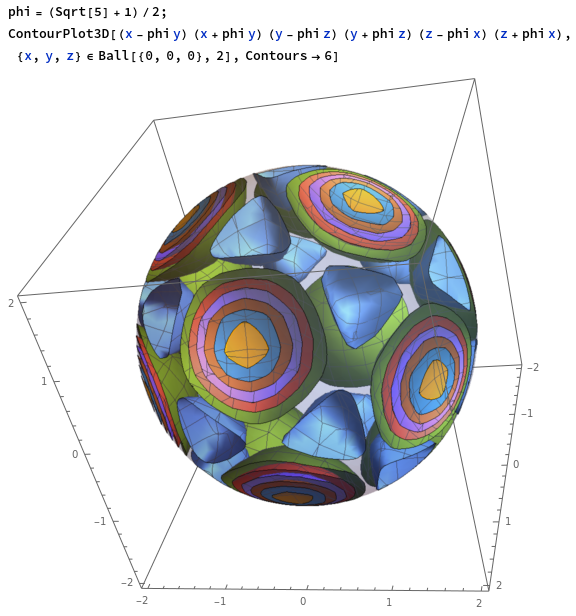
*in particular, the Griess algebra product and ambient inner product induce a symmetric trilinear real-valued function of three vectors, u.(v × w), whereas the dodecahedral potential is a non-linear real-valued function of a single vector.
Conway’s construction of the Monster group likewise begins with a maximal monomial subgroup, N0 = 2^35 (S3 × M24), and generates the Monster by adding an exotic element. But the construction is much more complicated, because:
- the smallest dimension of a faithful representation of the Monster is 196883, compared with just 3 for the group A5;
- the ambient 196883-dimensional space is a hodgepodge of multiple spaces, constructed in terms of various exceptional objects such as the Leech lattice, Golay code, and Parker loop.
Perhaps we could instead describe the Monster as the group of rotations fixing a set of vertices, in the same way that A5 can be described as the group of rotations fixing the 20 vertices of a dodecahedron? Again, this is possible: there’s a permutation representation on 97239461142009186000 vertices, namely the axes fixed by the centralisers of a certain important conjugacy class of elements in the Monster group (known as ‘transpositions’, ‘type-2A elements’, ‘short involutions’, or ‘Fischer involutions’).
The slight problem is that there are too many such vertices to write down explicitly. But maybe we can utilise the monomial subgroup, in the same way we did for A5: instead of listing all 20 vertices of the dodecahedron, it sufficed to list two of them, namely (1, 1, 1) and (0, φ, -1/φ), since the others are the images of one of these vertices under the action of the monomial subgroup.
Describing lattice points using the monomial subgroup
This same strategy (of describing a monomial subgroup together with a representative of each orbit) has already shown success in terms of studying one of the less complicated exceptional objects, the Leech lattice, where coordinates for the 196560 minimal nonzero vectors can be described efficiently as the set of images of:
- (-3, 1, 1, 1, 1, 1, 1, 1, 1, 1, 1, 1, 1, 1, 1, 1, 1, 1, 1, 1, 1, 1, 1, 1);
- (4, 4, 0, 0, 0, 0, 0, 0, 0, 0, 0, 0, 0, 0, 0, 0, 0, 0, 0, 0, 0, 0, 0, 0);
- (2, 2, 2, 2, 2, 2, 2, 2, 0, 0, 0, 0, 0, 0, 0, 0, 0, 0, 0, 0, 0, 0, 0, 0);
where there are 98304 images of the first vector, 1104 images of the second vector, and 97152 images of the third vector. The monomial subgroup is the full automorphism group 2^12 (M24) of the binary Golay code (viewed as a subset of the vertices of a 24-dimensional cube, {-1, 1}^24) generated by coordinate permutations in M24 together with patterns of sign changes which coincide with elements of the Golay code. The Conway group Co0 is then generated by this monomial subgroup together with an exotic element, as before.
For the 20 vertices of the dodecahedron, we ended up with 2 orbits of points. For the 196560 minimal vectors of the Leech lattice, we have 3 orbits of points. We can ask the concrete question:
How many orbits are there, under the monomial subgroup N0 of the Monster group, of the 97239461142009186000 type-2A axes?
along with the natural follow-up questions:
What are the sizes of the orbits? And can we concisely describe coordinates of representatives of each orbit?
This set of vertices (whose automorphism group is the Monster) might give us more insight into the group, as well as providing a more convenient means of calculating with the group. There’s a Python package by Martin Seysen (from this year!) that could prove useful in trying to answer these questions.
We can also ask whether there’s a nice lattice associated with the Monster group, in the same way that the Leech lattice is associated with the Conway group Co0. There’s an allusion in Conway’s paper to such a lattice being investigated by Simon Norton, but this seemed to be a dead-end: I couldn’t find anything further on the topic, despite asking on MathOverflow.
Fortunately, Richard Borcherds (who won a Fields Medal for proving the monstrous moonshine conjecture) gave a talk on sporadic groups for the Archimedeans, and I was able to ask him about Norton’s lattice.
He responded by mentioning that he recalled that Norton’s lattice didn’t turn out to be unimodular, but that Scott Carnahan had recently constructed a unimodular lattice with Monster group symmetries. Carnahan obtains this lattice (in corollary 3.24) as the weight-2 subspace of an integral form he constructs on the monster vertex operator algebra, an infinite-dimensional graded algebra of which the Griess algebra is the weight-2 subspace.
It would be instructive to translate Carnahan’s lattice into the computationally convenient coordinate system used in Conway’s construction. This would hopefully allow one to study the geometry of the lattice by describing the shells of the lattice as unions of orbits of vectors under the monomial subgroup.
There are 12 orbits of $2^{1+24}.Co_1$ on the 2A axes, see S.P. Norton, Anatomy of the monster I. In: The Atlas of Finite Groups: Ten Years On, pp 198-214. Cambridge University Press, 1998.
Studying these orbits was a crucial ingredient for speeding up the group operation in my mmgroup package, so that it became useful in practice
That large 54 digit number can be factorized into six pairs of numbers.
From memory , one side of the pair would be a “number of prime factors of (n-2)!”,
or briefly in the following demonstration, abbreviated as A(n-2).
the other side of the pair would simply be factorial of (n-2).
As an amarture experiemment, it was found that
The equation to calculate the order of Monster Group,
was
M=
A(37-2) x A(25-2) x A(27-2) x A(32-2) x 196560
(37-2) ! x (25-2)! x (27-2)! x (32-2)!
in which 196560 relates to Leech lattice
since
196560
= 9! X 13 / 24
= 9! X A(9) / 24
M =
A(37-2) x A(25-2) x A(27-2) x A(32-2) x A(13-2-1) x
(37-2) ! x (25-2)! x (27-2)! x (32-2)! X (13-2-1)!
And more completely…
M=
A(37-2) x A(25-2) x A(27-2) x A(32-2) x A(13-2-1) x (1) x
(37-2) ! x (25-2)! x (27-2)! x (32-2)! X (13-2-1)! x(1)!
There are several levels of similar equations on several levels.
M
=A(37^1-2) x A(5^2-2) x A(3^3-2) x A(2^5-2) x A(11-2) x (1) x
(37^1-2) ! x (5^2-2)! x (3^3-2)! x (2^5-2)! X (11-2)! x(1)!
Simply see. numbers 1+2+3+5=0+11 appear
which are the ( factors of 12) minus one.
1×12=2×6=3×4
–> 0,11, 1,5 ,2,3
the above selection of numbers appear again in
2^12=4096=
=(37^1)+(5^2)+(3^3)+(2^5)+(11) +(1^0) +
+(2^1)+(2^2)+(2^3)+(2^5)+(2^11)+(2^0)
And similarly, if 1,2,3,5 are separated from 0 and 11
2^12-1=
=(37^1)+(5^2)+(3^3)+(2^5)+
+(2×1)+(2×2)+(2×3)+(2×5)
and
6^2-1=
=(11) +(1) +
+(2×11)+(1).
The numbers 37,25,27,32
I had tried to demystify.
Given the three ways to express twelve as pairs multiplied
3×4=2×6=1×12
Add them up it is 28 which is 27 if one is excluded
Given the M distantly relates to 2^12,
That is 8x8x8x8, which adds up to 32
Given M is distantly related to 2^12,
25=2×12+1
And after investigation.
The eight triangular number =36
The seventh “circular number”* =37,
The sixth square number is 36,
The fifth pentagonal number is 35,
The fourth centered hexagonal number is 37,
The third sum-of-cube is 36,
Any number is on the number line (2D),
Any number has its own right of existence (1D).
This explains 37.
Where many square logic (eg multiplication, expotentiation) and nongsquare logic is contained in one number. Maybe I should have used another word, such as symmetry group, instead of “logic”.
*=1,3,7,12,19,27,37,Which is the arbitrarily stepwise expansion of tightly and hexagonally symmetrically added pennies on a table,
Given in 2D the kissing number is 6,
This circular number partly resembles hexagonal numbers.
Please read more on OEIS.
In my previous comment I made a mistake
I have forgotten to type “divide by 24”
Thus it is
24M =
A(37-2) x A(25-2) x A(27-2) x A(32-2) x A(13-2-1) x (1) x
(37-2) ! x (25-2)! x (27-2)! x (32-2)! X (13-2-1)! x(1)!
Rather than simple M
Is should have been written as 24M
I made a mistake in comments forgetting to write the “S”igma sign for
2^12=4096=
=S(37^1)+S(5^2)+S(3^3)+S(2^5)+S(11) +S(1^0) +
+(2^1)+(2^2)+(2^3)+(2^5)+(2^11)+(2^0)
Blow up your head I hate you
It is noteworthy that the first four Fibonacci numbers, their arithmetic Union as 11, and their absence as zero, are exactly what makes up the exponents of both 2¹²equation and the 24M equation.
Another number that was involved would be
37 is being the twelfth prime number.
Through these two equations,
The first four Fibonacci numbers form 6 components as 6 pairs,
That distantly reproduce the entire size of the Monster Goups as 24M.
Sorry I made a terrible mistake.
The equation is something like one of these two.
I am recalling this from memory after using calculators online that can calculate very very large numbers. If you want to recover the equation by decomposing the size of the monsign group into smaller components which are the six pairs of them with exponents relating to 1,2,3,5, and 0,11, think in these directions.
24M =
=A(2^1-2) x A(2^2-2) x A(2^3-2) x A(2^5-2) x A(2^(11-2)) x (2^0) x
(37^1-2) ! x (5^2-2)! x (3^3-2)! x (2^5-2)! X (11-2)! x(1)!
24M =
=A(2^1-2) x A(2^2-2) x A(2^3-2) x A(2^5-2) x A(2^(11-2)) x (2^0) x
(37^1-2) ! x (5^2-2)! x (3^3-2)! x (2^5-2)! X (11-2)! x(1)!
24M =
=A(37^1-2) x A(5^2-2) x A(3^3-2) x A(2^5-2) x A(11-2) x (1) x
(2^1-2) ! x (2^2-2)! x (2^3-2)! x (2^5-2)! X (2^11-2)! x(2^0)!
M refers to the size of the monster group.
A(n) represents the number of prime numbers in number n (or was it “n!” ).
Really is such an equation but I really cannot recall it at this moment so I can only write it down whenever I found a mistake and correct them whenever I can sorry.
If I know the actual equation I will put it back here.
24M =
(11-2)! · 2⁵! · 2³! · 2²! · 2¹! · 2⁰! ·
Ω((11-2)!) · Ω((2⁵-2)!) · Ω((3³-2)!) · Ω((5²-2)!) · Ω((37¹-2)!)· 1⁰
Just like
2¹² =
Sum(11) + Sum(2⁵) + Sum(3³) + Sum(5²) + Sum(37¹) + Sum(1⁰)+
2¹¹ + 2⁵ + 2³ + 2² + 2¹ + 2⁰.
Please notice these numbers
Set one ((5+3+2+1),5,3,2,1,0)
Set two ((5+3+2+1),5,3,2,1,0)
Within both equations.
Written by Bill Yuen Hung CHAN on 17-04-2026, HKSAR.
I hope someone calls it Bill’s Notation, or Bill’s Tetrad Notation, because of the special properties of 5,3,2,1, their sum as 11 and their absence as 0.
I hope the similarity of this equational format of 24M to 2¹², might hint us a clue to the reason to include 24 as 12×2.
It is an elegant equation, to divide an object related to number 12, into exactly 12 members, or actually six pairs of concepts relating to 11,5,3,2,1,0.
Thank you very much
5321 holds many properties
If you add one to all numbers, they become multiplicative factors of 12.
If you reduce one from own numbers, they become powers of 2, with zero.
If the four numbers themselves are replaced by four ones, you add these sixteen numbers and your result into 37.
2 and 3 and 5, are the first 3 prime numbers that adds up to 10,
Which parallels to the first 3² prime numbers that adds up to 10².
And if you divide the rest of the numbers from 1-28 into the nine prime numbers as Prm(2,3,5,7,11,13,17,19,23) and the whole powers as Pwr(1,2²,2³,3²,2⁴,5²) and Neithers (since neither-Prime-nor-Power has the word Neither sound like Peter my friend)
Pet(2¹3¹,2¹5¹,2²3¹,2¹7¹,3¹5¹,2¹3²,2²5¹,3¹7¹,2¹11,2³3¹,2¹13,2²7¹), but excluding 27,
You can notice that from 1 to 28, if you exclude number 27,
The sum of Prime(2,3,5,7,11,13,17,19,23)= (2+3+5)²
The sum of Powers(1)+Powers(1,4,8,9,16,25)=4³-1³
The sum of Peters(6,10,12,14,15,18,20,21,22,24,26,28)=6³
Of which the sums can be produced by the members of the group itself.
But 27 has to be excluded for some reason.
This logic leads to 27.
The grouping might have to be changed slightly to produce a more neat and professional trend.
If you do the same thing to 1-48,
If you treat 1 as a group by itself,
You can find that there are 3²-1, 4²-1, 5²-1 Powers, Primes, Peters.
Exceptional :
01
Powers :(3²-1)
04,08,09,
16,25,27,
32,36.
Primes: (4²-1)
02,03,05,07,
11,13,17,19,
23,29,31,37,
41,43,47.
Peters: (5²-1)
06,10,12,14,15,
18,20,21,22,24,
26,28,30,33,34,
35,38,39,40,42,
44,45,46,48.
In this manner not a single number is missing.
Considering that 3²-1,4²-1,5²-1 are represented by the famous Pythagorean equation 3²+4²=5²
And that these three numbers respectively seem to represent quite naturally
Powers Primes and Peters,
I think that the pythagorean equation has a deeper meaning.
Which states that it is always possible to PARTITIONING a “neither” number into exactly one prime and exactly one power.
I really hope to make it easier for us to remember using
a more fun description of the PARTITION process :
PARTY Peter = Prime + Power.
Eg. 6=2+4
6 = neither prime nor power (aka: Peter!)
2 = prime
4 = power
It must be noted that there are two ways to use this equation.
To consider number one as a part of power due to the logic from 1-28.
Or to
consider number one as a special exclusioned group in itself due to the logic from 1-48.
These two considerations lead to the special property of number 24,
That
If all positive integers eventually fit into Peter’s Party Equation,
Number 24 is the only special case, 24=1+23
That it cannot be represented without using number one.
Although I am unable to calculate whether only number 24 cannot be represented unless number one is involved.
All other Peter numbers seem to fit into an equation without the usage of number one.
By a layman’s logic, unprofessionally guessing, 24 might only be such a number.
I hope that this special property of number 24 from Peter’s Party Equation,
may shed a light onto 24 and 2¹² as equations that relate to the size of the Monster Group.
I HAVE ALSO DREAMED THAT PETER’S PARTY EQUATION COULD HAVE OTHER VERSIONS THAT MIGHT BE HINTED BY WHAT I CALLED THE GIZA.
For example 3³+4³+5³=6³
The Sphinx :
54²=some of all the thirty nine numbers of all the three pyramids
Pyramid One, base increases index increases.
2²=2²
1¹+2²+3³=2⁵
0⁰+1¹+2²+3³+4⁴=17²
Pyramid Two, base unchanged while index increases
0⁰=1⁰
26⁰+26¹=3³ (special case which is exactly half of Sphinx, 27=54/2)
18⁰+18¹+18²=7³
7⁰+7¹+7²+7³=20²
3⁰+3¹+3²+3³+3⁴=11²
Pyramid Three, base increases while index unchanged
3²+4²=5²
3³+4³+5³=6³
There are two special observations with this one’s sphinx and three pyramids.
In how a whole power can be understood as a hypercube with the base being the length and the index being the number of dimension ,
I recall if you use exactly the same set of numbers in a certain way, the 10 equations will sum to a nice result. I might have to re message to explain what I’m trying to say.
The second observation is that
There is 1 line in Sphinx, 2 , 3, 5 equations in the three Pyramids.
The numbers 2⁵,5²,3³,37¹ are related to each other as with 0 and 11.
2⁵+5²+3³+37¹=11²=(1+2+3+5)², which is also 3⁰+3¹+3²+3³+3⁴ and 5!+1.
If we consider the equation
2¹² =
Sum(11) + Sum(2⁵) + Sum(3³) + Sum(5²) + Sum(37¹) + Sum(1⁰)+
2¹¹ + 2⁵ + 2³ + 2² + 2¹ + 2⁰.
We put 1,2,3,5 into one cluster, and 0,11 into another cluster,
The sum of the product of their base and indexes for the powers of,
And the rest of numbers without being a “sum of function” will be :
143=
36×4-1=
2⁵+5²+3³+37¹+
25+22+23+21
and
35=
36×1-1=
11+1+
2*11+0
Note that 25+52+33+371= sum(11)=sum(1+2+3+5).
Please note that 37 is a 12th prime number as well.
the stars are missing
143=
36×4-1=
2⁵+5²+3³+37¹+
2×5+2×2+2×3+2×1
35=
36×1-1=
11+1+
2×11+0
2×5+5×2+3×3+37×1= sum(11)=sum(1+2+3+5).
(added information for easier read)
2¹² = 4096
Sum(11) + Sum(2⁵) + Sum(3³) + Sum(5²) + Sum(37¹) + Sum(1⁰)+
2¹¹ + 2⁵ + 2³ + 2² + 2¹ + 2⁰
66 + 528 + 378 + 325 + 703 + 1 +
2048 + 32 + 8 + 4 + 2 + 1
And for the monster group M ,
24M = 24 · 808017424794512875886459904961710757005754368000000000
(11-2)! · 2⁵! · 2³! · 2²! · 2¹! · 2⁰! ·
Ω((11-2)!) · Ω((2⁵-2)!) · Ω((3³-2)!) · Ω((5²-2)!) · Ω((37¹-2)!)·1⁰
9! · 32! · 8! · 4! · 2! · 1! ·
13 · 59 · 47 · 41 · 71· 1
Notice eleven is sum of
One Two Three and Five,
Notice these few number as you read the equatons :11=5+3+2+1
(added information for easier read)
2¹² = 4096
Sum(11) + Sum(2⁵) + Sum(3³) + Sum(5²) + Sum(37¹) + Sum(1⁰)+
2¹¹ + 2⁵ + 2³ + 2² + 2¹ + 2⁰
66 + 528 + 378 + 325 + 703 + 1 +
2048 + 32 + 8 + 4 + 2 + 1
And for the monster group M ,
24M = 24 · 808017424794512875886459904961710757005754368000000000
(11-2)! · 2⁵! · 2³! · 2²! · 2¹! · 2⁰! ·
Ω((11-2)!) · Ω((2⁵-2)!) · Ω((3³-2)!) · Ω((5²-2)!) · Ω((37¹-2)!)·1⁰
9! · 32! · 8! · 4! · 2! · 1! ·
13 · 59 · 47 · 41 · 71· 1
Notice eleven is sum of
One Two Three and Five,
Notice these few number as you read the equatons :11=5+3+2+1
(added information for easier read)
2¹² = 4096
2¹²=Sum(11) + Sum(2⁵) + Sum(3³) + Sum(5²) + Sum(37¹) + Sum(1⁰)+
2¹¹ + 2⁵ + 2³ + 2² + 2¹ + 2⁰
2¹²=66 + 528 + 378 + 325 + 703 + 1 +
2048 + 32 + 8 + 4 + 2 + 1
And for the monster group M ,
24M = 24 · 808017424794512875886459904961710757005754368000000000
24M=(11-2)! · 2⁵! · 2³! · 2²! · 2¹! · 2⁰! ·
Ω((11-2)!) · Ω((2⁵-2)!) · Ω((3³-2)!) · Ω((5²-2)!) · Ω((37¹-2)!)·1⁰
24M=9! · 32! · 8! · 4! · 2! · 1! ·
13 · 59 · 47 · 41 · 71· 1
Notice eleven is sum of
One Two Three and Five,
Notice these few number as you read the equatons :11=5+3+2+1
notice parallel between 2¹² and 24M.
2¹²= Sum(11) + Sum(2⁵) + Sum(3³) + Sum(5²) + Sum(37¹) + Sum(1⁰)+
2¹¹ + 2⁵ + 2³ + 2² + 2¹ + 2⁰
24M= Ω((11-2)!) · Ω((2⁵-2)!) · Ω((3³-2)!) · Ω((5²-2)!) · Ω((37¹-2)!)·1⁰·
(11-2)! · 2⁵! · 2³! · 2²! · 2¹! · 2⁰!
24M=
13 · 59 · 47 · 41 · 71· 1·
9! · 32! · 8! · 4! · 2! · 1!
I have put in onto Wikipedia already