Kaleidoscopes

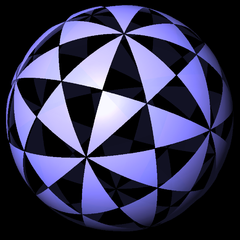
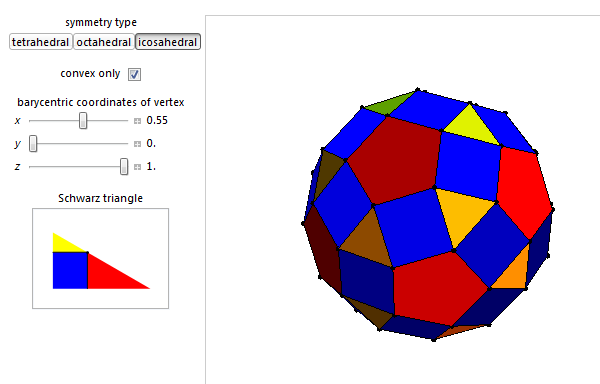
For the third time on cp4space, I’m going to refer to my Wythoffian polyhedron generator. This constructs a polyhedron by the use of some two-dimensional fundamental region, bounded by mirrors meeting at predetermined angles. For example, a triangle with internal angles of π/2, π/3 and π/5 generates polyhedra with icosahedral symmetry:
wythoff

Now, we can compute the Euler characteristic of a fundamental region, and use this to determine the number of copies of the fundamental region necessary to tile a surface of a particular genus. For instance, when the fundamental region is a triangle with internal angles of π/p, π/q and π/r, the Euler characteristic of the region is:

\chi = V + F - E = \dfrac{1}{2p} + \dfrac{1}{2q} + \dfrac{1}{2r} + 1 - \dfrac{3}{2}

More generally, for an arbitrary polygon, we have:

  • V is the sum of interior angles divided by 2π;
  • E is half of the number of edges;
  • F = 1.

In the icosahedral case, we have \chi = \dfrac{1}{60}, so we need 120 copies of the fundamental region to tile this sphere (which has an Euler characteristic of 2). Instantly, we can determine from a polygonal kaleidoscope whether it generates an elliptic, flat or hyperbolic tessellation, and determine how many times it covers the region.

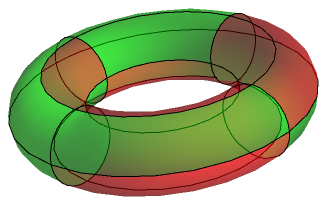
Let’s try another one, namely the hyperbolic triangle with interior angles of π/2, π/3 and π/7. This gives an Euler characteristic of \chi = -\dfrac{1}{84}. It can tile a three-holed torus (Euler characteristic −4) with 336 copies, arranged in a nice structure with automorphism group PGL(2,7).

What about using squares to tile a torus? This ends up being indeterminate, since the Euler characteristic of the torus and the square are both 0. The same applies to tiling a Klein bottle with hexagons, or a Euclidean plane with triangles.

More complicated kaleidoscopes

To describe groups generated by reflections in higher dimensions, one generally uses a Coxeter-Dynkin diagram. I’ve briefly discussed these before, so I’ll not reintroduce these remarkable objects. Instead, we shall concentrate on simply-laced Dynkin diagrams (all edges are unlabelled) that are simply-connected and have at most one vertex with degree greater than two. For example, the E8 diagram has branches of length 2, 3 and 5:
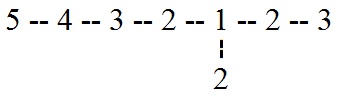
e8

These are analogous to the 2, 3 and 5 in the dodecahedral symmetry group, and the analogy is related to the McKay correspondence. It’s also mentioned here, although we’ll approach it with slightly more generality. We associate a Dynkin diagram with one multivalent vertex with a polygon, whose internal angles are given by π/l, where l is the length of the branch. Hence, the D4 affine diagram corresponds to a rectangular fundamental region:
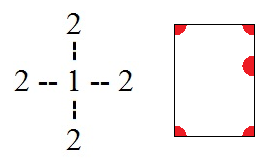
d4-affine

It’s also well defined, since measuring angles of π on the edges of the polygon corresponds to branches of length 1 (the central node in the diagram). The thing that really makes this connection natural is the following:

  • The Dynkin diagram is finite/affine/hyperbolic precisely when the surface generated by the two-dimensional kaleidoscope is spherical/flat/hyperbolic, respectively.

So, the rectangular kaleidoscope *2222 (in Thurston’s orbifold notation) corresponds to the D4 lattice, and they both generate flat tilings. Other correspondences are below:

Spherical:

  • Dihedral symmetry *22n ↔ D(n+2)
  • Tetrahedral symmetry *332 ↔ E6
  • Octahedral symmetry *432 ↔ E7
  • Icosahedral symmetry *532 ↔ E8

Flat:

  • *2222 ↔ affine D4
  • *333 ↔ affine E6
  • Square tiling symmetry *442 ↔ affine E7
  • Hexagonal honeycomb symmetry *632 ↔ affine E8

Hyperbolic:

  • *732 ↔ hyperbolic E9 lattice
  • *666 ↔ hyperbolic Coxeter group containing the bimonster as a quotient

Unfortunately, I can’t see how this would generalise to the affine Dn diagram (for n >= 5), since the diagram has two vertices of degree 3. Similarly, this doesn’t work particularly well for the regular An diagram, which is just a straight line:

  • A7 = 4—3—2—1—2—3—4

So, according to our correspondence, this gives this hosohedron:
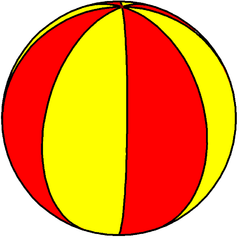
Now, there is a certain ambiguity in the construction. For example, what if we had labelled A7 using an off-centre root node?

  • A7 = 5—4—3—2—1—2—3

This would correspond to a digonal fundamental region with angles of π/3 and π/5, which just doesn’t work properly. Hence, we had no choice but to choose the centre node. A more awkward repercussion is that this is only possible for odd n. For example, the hosohedra for A3 and A5 are shown below, but the construction fails for A4.
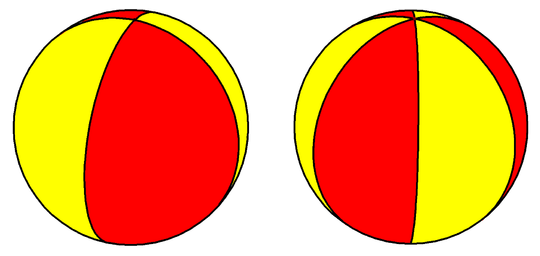
hosohedra

Well, that is at least suggestive of what A4 should correspond to: a hosohedron with five lunes, alternately coloured. When one attempts to construct it, serious difficulties are encountered. However, we can avoid those complications by using the double cover of the spherical symmetry group, in which case we recover the original McKay correspondence.

We can also make sense of some infinite Coxeter diagrams. For example, the E∞ diagram (limit of En for all n, which gives an infinitely-generated Coxeter group) below corresponds to the *23∞ symmetry group (isomorphic to the modular group PGL(2,Z)):

e-infinity

I don’t think that this analogy between Dynkin diagrams and two-dimensional kaleidoscopes is anything other than a convenient mathematical coincidence, although it seems to be intimately related to the McKay correspondence.

Posted in Uncategorized | Leave a comment

Cipher 39: Unknown location

The following image should be sufficient for you to determine the password to a reasonable degree of accuracy:

Click to enlarge

Click to enlarge

Posted in Ciphers | Leave a comment

Fair dice

(I’m testing out the functionality of the cp4space Facebook page. Hopefully, this post should be automatically published there.)

In most familiar board games, cubic dice are used on the basis that each face is equally likely to face upwards. In prehistoric times, tetrahedral bones were used, and other polyhedral dice are prevalent nowadays. It is not too difficult to see that all regular, and indeed all face-transitive, dice are all trivially unbiased.

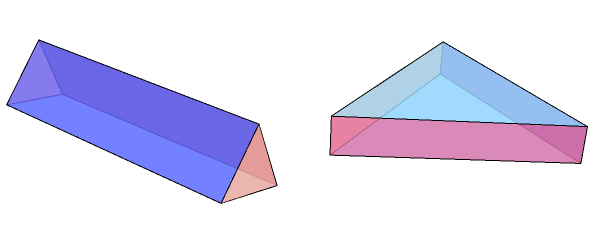
What about dice which are not face-transitive? Brent Meeker gave a non-constructive example of such a die. Consider an equilateral triangular prism. By choosing the proportions, it is possible to make the triangular faces more likely than the rectangular faces, or vice-versa.

prisms

By the Intermediate Value Theorem, we can find some optimal ratio that gives all faces a probability of 1/5. However, this ratio is dependent on the physical model. We’ll consider two plausible physical models here, and show that each of them give a different optimal proportion.

  1. The LGS model: We have a large vat of Lyle’s Golden Syrup, into which we drop the die vertically. In this model, the fluid is sufficiently viscous that the inertia of the falling die can be ignored. Specifically, the die falls vertically until a vertex touches the base of the vat. Then, gravity causes the die to roll onto the face directly below the centroid. The probability of a face is proportional to the solid angle subtended by the face from the centroid if the projection of the centroid lands inside the face, and zero otherwise.
  2. The agitated adhesive model: The die rests on the surface of a steel drum, which is covered in glue. Every second, the drum is hit by a long metal baton, causing the die to spontaneously jump into the air. Each time it lands, there is a probability (an increasing function f, proportional to the kth power of the contact area) of the die permanently sticking to the surface of the drum. As k tends to infinity, a fair die must have all faces with equal area.

With a little help from RIES, I was able to determine that the ratio of edge lengths for a fair die in the LGS model is \dfrac{2 \sqrt{\sqrt{5}}}{\sqrt{3} (1+\sqrt{5})}, compared with \dfrac{\sqrt{3}}{4} in the limit of the agitated adhesive model.
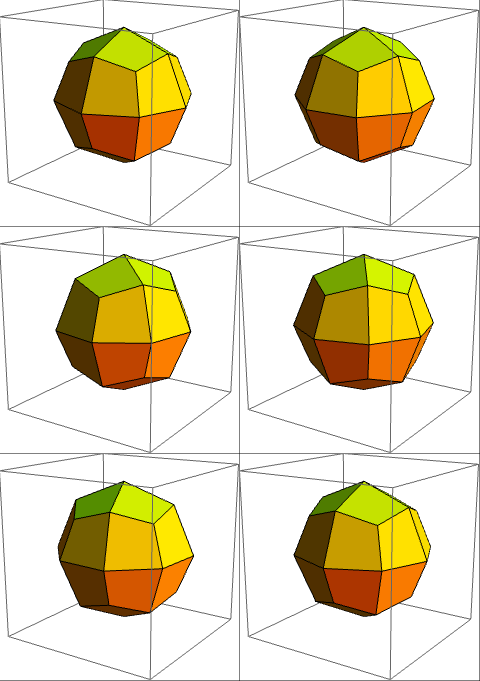
Pseudo-deltoidal icositetrahedron

The closest thing to a uniform polyhedron without being itself uniform is one of the Johnson solids, the elongated square gyrobicupola. Its projective dual is thus almost face-transitive without actually being face-transitive. It’s a fair die in both of the models shown above, as well as absolutely any other physical model I can imagine. It has the following properties:

  • All faces are congruent;
  • The incentre and centroid are well-defined and coincide;
  • The inertia tensor is isotropic.

A rotating model of the pseudo-deltoidal icositetrahedron is below:

pseudo

Does there exist a natural physical model in which the pseudo-deltoidal icositetrahedron is not a fair die? In particular, is this the case for the simple Newtonian model?

Posted in Uncategorized | Leave a comment

Seven-dimensional cross product

In three dimensions, the familiar cross product is a bilinear function expressible in terms of the Levi-Civita alternating tensor. Specifically, a = b × c can be written as ai = εijk bj ck, which has the following beautiful properties:

  • Bilinearity: a is a linear function of b (when c is fixed), and a linear function of c (when b is fixed);
  • Complete antisymmetry: swapping any two of the indices flips the sign of the tensor;
  • Orthogonality: a is always perpendicular to b and c;
  • Isotropy: the tensor is unchanged when transformed in SO(3).

It should be evident that for orthogonality and isotropy, the cross product can only be defined in three dimensions. In two dimensions or lower, there are insufficiently many dimensions for orthogonality. On the other hand, in four or more dimensions, we can apply a rotation that preserves b and c whilst changing a, so the cross product cannot be well defined. Hence, it only exists in three dimensions (unless it is identically zero, which is stupid and trivial).

However, if we relax the condition of total isotropy, there exists a seven-dimensional analogue of the cross product. It is uniquely determined (up to automorphism of the underlying vector space) by the following conditions:

  • Bilinearity;
  • Complete antisymmetry;
  • Orthogonality.

Even though it doesn’t have full isotropy (i.e. the automorphism group of the tensor is smaller than SO(7)), it still retains a lot of symmetry. The automorphism group is the compact real form of the exceptional Lie group G2.

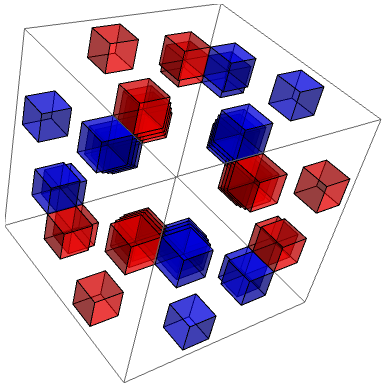
If we choose the canonical coordinate system, then the components of the tensor can be visualised as a three-dimensional array (where blue and red are +1 and −1, respectively):

7dtensor

The projection shown above highlights the antisymmetry of the tensor — reflecting in an axis causes the colours of the entries to alternate. Note that the position (x, y, z) is non-zero if and only if x, y and z are collinear on (a particular labelling of) the Fano plane.

Quaternions and octonions

With a slight abuse of notation, one can write a quaternion as a sum of a scalar and vector, such as λ + a, where λ is the real part and a is the (three-dimensional) imaginary part. Then, the rule for multiplying quaternions becomes:

  • (λ + a)*(μ + b) = (λμ − a · b) + (λb + μa + a × b)

In fact, if we define the one-dimensional cross product to be identically zero, then this is also the definition of multiplying complex numbers. Using a seven-dimensional cross product, we obtain the rule for multiplying weird eight-dimensional entities called octonions. Whilst quaternions are slightly bad (they’re not commutative), octonions are really bad (they’re non-associative, which means you need to use parentheses in products of three or more octonions)!

There’s a book by John Conway and Derek Smith about quaternions and octonions. Rather informatively, it’s entitled On Quaternions and Octonions.

Split octonions

The (squared) norm of an octonion is defined to be the sum of the squares of its components, just as one would define the norm of a complex number. Equivalently, we can consider it to be the length of an octonion as a vector in eight-dimensional space.

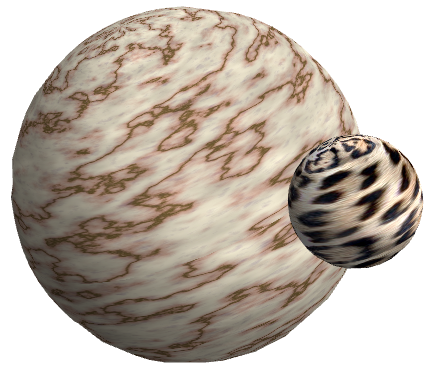
It transpires that the octonions have a more pathological cousin, the split octonions, where four of the coordinates are spacelike and the other four are timelike. In other words, they live in a (4+4)-dimensional Minkowski space. When the (seven-dimensional) subspace of purely imaginary octonions is projectivised (the origin is thrown away and real scalar multiples are associated), we get a beautiful six-dimensional projective space. John Baez and Huerta discovered that this is precisely the space of positions of a spinorial ball rolling on the surface of a projective ball of three times its diameter.

planets

Moreover, lines in this six-dimensional space are defined in a natural way, both in terms of the octonionic representation (as subplanes where all products have a norm of zero) and in terms of the rolling balls (as geodesic trajectories where the smaller ball rolls along a great circle of the larger ball).

And the symmetry group of this six-dimensional projective space? The split form of G2, naturally…

Posted in Uncategorized | Leave a comment

De Bruijn sequences

Given a finite alphabet Σ of size s and an integer n, a de Bruijn sequence is a cyclic string of s^n symbols, such that each n-symbol string over Σ appears exactly once. For example, taking Σ to be an alphabet of four colours and choosing n = 3 gives the following de Bruijn sequence of length 64:
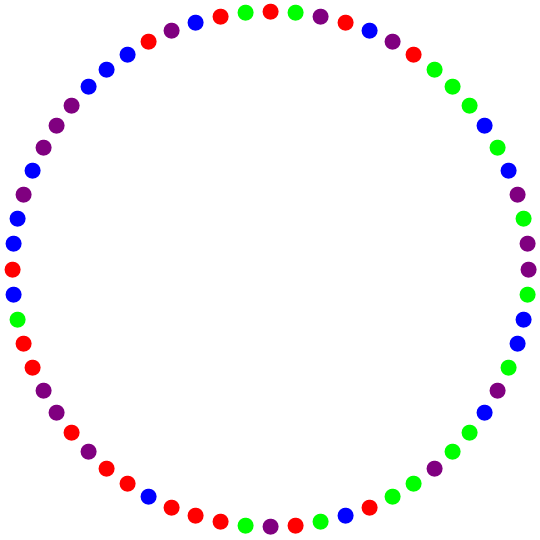
de-bruijn-torus

It is, quite obviously, the shortest (oriented) loop that contains all possible strings of length 3 over an alphabet of 4 symbols. If we take the alphabet to be the four nucleotide bases of DNA, then this loop of 64 base pairs has the following interesting property: it contains all 64 possible DNA codons.

If one were to actually realise this loop of DNA and effect the process of transcription, then a continual periodic string of RNA would be produced, forming at a site which constantly circumnavigates the DNA loop. Due to the serendipity of 3 and 64 being coprime, this would be translated into a period-64 sequence of all possible amino acids.

Another application of de Bruijn sequences is attempting to break into an electronic safe, which opens when the last four digits pressed matches a particular passcode. The naïve approach of trying each passcode in lexicographical order involves 40000 key presses:

00000001000200030004 [...] 99959996999799989999

Much more efficient is the use of a de Bruijn sequence, which (when the first three digits are re-appended to the end to produce a linear, rather than cyclic, string) is only 10003 digits long.

It can be shown that de Bruijn sequences exist for any ordered pair (s, n), and that the number of such sequences is \dfrac{(k!)^{k^{n-1}}}{k^n}. Even more impressive is that the concept generalises to de Bruijn tori, which are known to exist in the square case. For example, here is a 4 \times 4 torus with 2 colours and every possible 2 \times 2 block as a subregion:

de-bruijn-torus2

Permutations instead of tuples

Nathaniel Johnston considers a similar problem, where the shortest linear string containing all permutations of {1, 2, …, n} is desired. Optimal solutions are known for n \leq 4, but larger cases are beyond the capabilities of brute-force exhaustive search.

The analogous problem to the electronic safe-cracking is a situation in which a monk has to ring every permutation of six monastery bells. The usual approach is to perform each permutation in succession by use of the Steinhaus-Johnson-Trotter algorithm. However, this particular monk is very lazy, so decides to employ the suspected optimal solution to reduce his workload from 4320 bells to just 873 (see Sloane’s A180632).

Posted in Uncategorized | Leave a comment

Cipher 38: 60 percent wordsearch

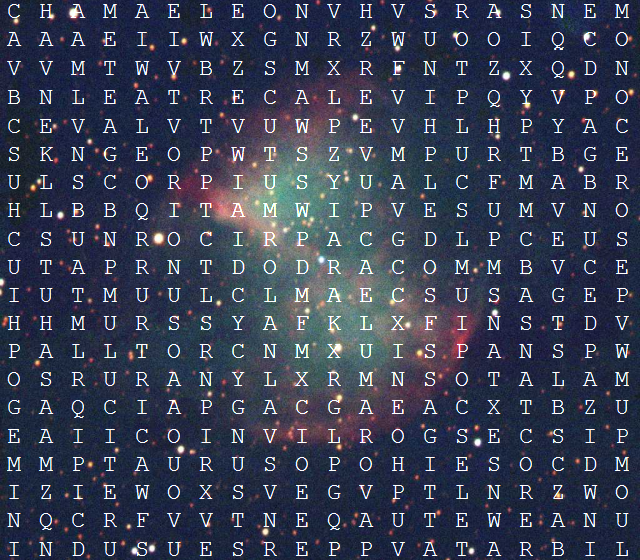
Update: In my blithering ineptitude, I accidentally missed the bottom row off of the cipher. It has now been amended, and should be a 20 × 20 grid:

40-percent-vigenere

The backdrop is a photograph of the Dumbbell Nebula, which I captured over a year ago by remotely controlling a two-metre optical telescope in Hawaii.

Posted in Ciphers | Leave a comment

Further news

As usual, I’ll start this post by mentioning the current state of the bounded gaps between primes project. The current values are k_0 = 720, H = 5414, with an unconfirmed result giving a value of H below 5000. It’s surprising how far these sieve methods are successfully being pushed — significantly below Ben Green’s estimate that 10000 would be the limit.

Anyway, the 54th International Mathematical Olympiad finished a few days ago. There are no prizes for guessing which country came first (China), closely followed by South Korea. The United Kingdom came first in the EU and ninth in the world, which is the best result since 1996. Congratulations go to Geoff Smith for leading the team, Dominic Yeo for acquiring refreshments (and the other things that deputy leaders do), and especially to the six excellent contestants* who, between them, attained two gold medals, three silvers and a bronze. This is an excellent achievement!

* In lexicographical order by surname, they are Andrew Carlotti, Gabriel Gendler, Daniel Hu, Sahl Khan, Warren Li and Matei Mandache. Andrew is now the country’s most prolific IMO contestant, with three gold medals and a bronze. Our other triple gold medallists are John Rickard (c.f. Treefoil) and Simon Norton (co-discoverer of the Harada-Norton sporadic group).

The next impending mathematical Olympiad worthy of mention is the Mathematical Olympiad for Girls (or MOG), which is used for finding the UK EGMO team. I’ll be mentioning it closer to the time, combined in an article with the Miracle Octad Generator (purely on the basis that they have the same acronym). I think that my recommendation that medals and certificates be awarded as opposed to gold stickers on returned scripts has been effected, although if this is not the case and you have been affected by this issue, do not hesitate to contact me.

In other news, Stuart Gascoigne recently overtook Joseph Myers on the cipher-solving leaderboard.

Posted in Uncategorized | Leave a comment

Converting problems into elliptic curves

Several geometric problems and Diophantine equations can be converted into the task of finding rational points on elliptic curves. The canonical example is to determine for which rational numbers n can a right-angled triangle with rational side lengths have an area of n. (The integers with this property are called congruent numbers.)

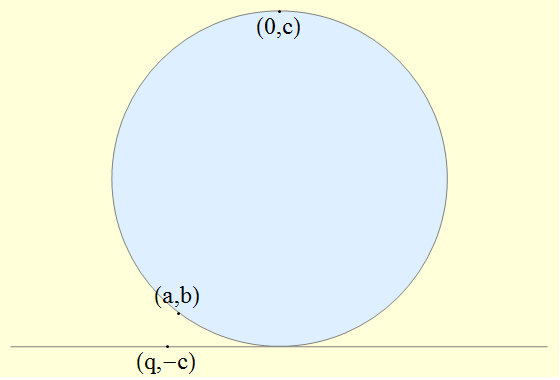
Before we can proceed, it is helpful to find all pairs of rational numbers (a, b) such that a² + b² = c², where c is a predetermined rational number. Equivalently, we want to find rational points on the circle of radius c, which is reasonably trivial. It is well known that if one root of a quadratic equation with rational coefficients is rational, then so must the other one. In particular, this means that the rational points on the circle are precisely the points for which the line in the following diagram has rational gradient:

stereo

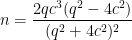
By geometric inversion in the circle with centre (0, c) and radius 2c, it is straightforward to derive that (a,b) = (\dfrac{4qc^2}{q^2+4c^2},\dfrac{cq^2-4c^3}{q^2+4c^2}) and n = \dfrac{2qc^3(q^2-4c^2)}{(q^2+4c^2)^2}. If you plot c and q on the complex projective plane, the resulting surface is a topological torus; it is said to have a genus (number of holes) of 1. This means that algebraic massage can convert it into an elliptic curve. Let’s attempt this. Firstly, we want a polynomial, so the obvious step is to eliminate the denominator:


2qc^3(q^2-4c^2) = n(q^2+4c^2)^2

For this to be in Weierstrass normal form, we want one side of the equation to be a square, and the other side to be a cubic function of a single variable. The right-hand side is almost a square itself, rectifiable by multiplying both sides by n³. Additionally, q and c are equidimensional, so we can do some further manipulation:

16(\dfrac{qn}{2c})(\dfrac{q^2n^2}{4c^2}-n^2)c^6 = n^4(q^2+4c^2)^2

Finally, dividing both sides by (4c³)² gives the beautiful elliptic curve:

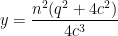
y² = x³ − n²x, where x = \dfrac{qn}{2c} and y = \dfrac{n^2(q^2+4c^2)}{4c^3}. It is easy to show that we can express q and c as rational functions of x,y,n, so rational points on this elliptic curve correspond to rational right-angled triangles with area n. Assuming the Birch and Swinnerton-Dyer conjecture, the existence of rational solutions can be verified by a finite calculation, so the congruent numbers are a recursive set. If the conjecture is false, however, then there is no known algorithm for computing the congruent numbers.

Posted in Uncategorized | Leave a comment

Cipher 37: Honeycomb II

As 37 is a centred hexagonal number, I decided to opt for a vaguely hexagonal arrangement:

totalistic

Click to enlarge.

As usual, there is a password-protected solvers’ area.

Posted in Ciphers | Leave a comment

Mathematical Ashes

The competition known as the Mathematical Ashes was created by analogy with the better-known cricketing Ashes, and is an annual competition between Britain and Australia. At the moment, Britain is in the lead, with Australia attempting to reduce the gap. Results should be released in the next 24 hours on Joseph Myers’ website.

For the convenience of being in the propinquity of the IMO location, the Ashes are taking place in Colombia. Last year, concerns were raised as to how difficult it would be to depart Colombia with a suspicious urn of white powder, and whether the airport security would believe some contrived story about a mathematical competition between Britain and Australia.

It transpires that this is not the only hype arising from this year’s competition. There is a website following the competition from an interesting point of view, which has been producing such delightful headlines as ‘Shakira in Ashes row’ (when she had no involvement whatsoever, other than being born in the right place several decades earlier).

Does anyone know who is responsible for this website? The skewed perspective and colloquialism ‘Pom’ is indicative of it being of Antipodal origin, although their esteemed leader Angelo Di Pasquale* would not lower himself to producing tabloid journalism. Hence, one can only assume that it is the opus of one of the members of the Australian team.

Anyway, the latest headline on the website portrays members of the British team as being economical with the truth, substantiating it with quotations**. I assure you that I have known not a single student who attempted this Machiavellian trick, and that the article is a gross travesty.

Footnotes

* Not, as James Cranch was quick to point out, related to the charitable bank robber Pasquale D’Angelo.

** Probably fabricated, since during my time as a student the term ‘cross’ was never used as an intransitive verb to refer to the obliteration of an erroneous proof.

Posted in Uncategorized | Leave a comment