MODA ready for review

After several rounds of editing and peer-review, I have decided that my book, Mathematical Olympiad Dark Arts, has reached a point where it is suitable for public review. Rather than upload the entire 176-page document in its entirety, I shall instead present it in instalments of one chapter per week.

  • Preface
  • Combinatorics I (enumerative and geometrical combinatorics)
  • Linear algebra
  • Combinatorics II (graph theory)
  • Polynomials
  • Sequences
  • Inequalities
  • Projective geometry
  • Complex numbers
  • Triangle geometry
  • Areal coordinates
  • The Riemann sphere
  • Diophantine equations
  • Conic sections
  • Glossary
  • Further reading
  • Acknowledgements

Please notify me of any errors or omissions, no matter how trivial, so that I can amend them before officially releasing the book.

Posted in MODA | Leave a comment

Closed-form bijections

One of the qualities of a quintessential British mathematician is the ability to invent crazy and contrived functions to satisfy particular properties. For instance, John Conway’s base-13 function was designed as a counter-example to the converse of the Intermediate Value Theorem. Another example is when most of the British RMM 2011 team found functions f and g over the reals such that f(g(x)) is strictly increasing and g(f(x)) is strictly decreasing.

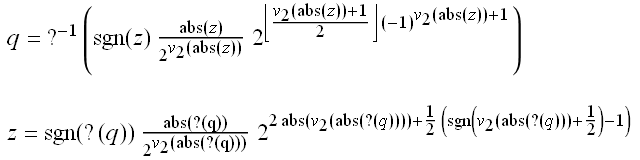
Later, I received news that someone was trying to find a closed-form bijection between the integers and the rationals. By ‘closed-form’, you need to be able to express z (an arbitrary integer) in terms of q (an arbitrary rational) using only well-known standard functions, and vice-versa. You’re not allowed infinite series, infinite products or anything else that would require an infinite amount of paper when expanded. Similarly, it’s considered cheating to use an irrational number you’ve defined yourself — but pi, e, phi etc. are all permissible.

I challenge you to find a significantly simpler closed-form bijection than the one presented below:

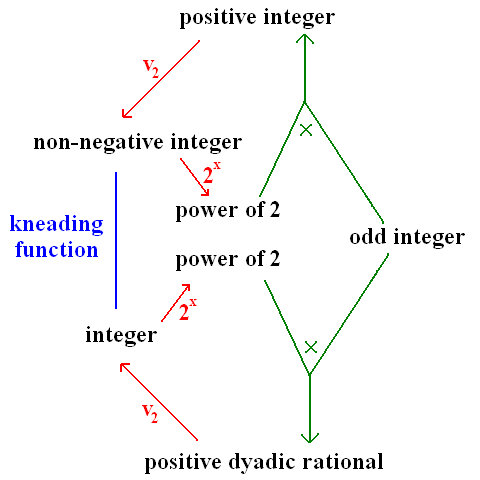
A closed-form bijection between integers and rationals

A closed-form bijection between integers and rationals

Yes, it’s pretty hideous. It boils down to the idea that any positive dyadic rational can be uniquely expressed in the form n*2^k where n is an odd natural number and k is an integer. Similarly, any positive integer can be uniquely expressed in the form n*2^k where n is an odd natural number and k is a non-negative integer. Together with a closed-form bijection between integers and non-negative integers, we have a way to interchange between positive integers and positive dyadic rationals.

Bijection between positive integers and positive dyadic rationals

Bijection between positive integers and positive dyadic rationals

The kneading function is actually a pair of functions: one which maps integers to non-negative integers, and one which reverses the process. I have chosen the bijection between the ordered lists {0,1,2,3,4,5,6,…} and {0,-1,1,-2,2,-3,3,…}. The 2-adic valuation function, v2(x), gives the largest integer y such that 2^y divides x.

Using the sgn() and abs() functions, we can extend this to a closed-form bijection between integers and dyadic rationals. It is an odd function, meaning that if q and z are paired in the bijection, then so are -q and -z. Hence, 0 maps to itself. We are now extremely close to fulfilling the task of bijecting between the integers and rationals; we just require a function to map the rationals to the dyadic rationals.

Fortunately, one already exists. The Minkowski question mark function is an amazing beast, which maps rationals to dyadic rationals. More impressive is the fact that it maps quadratic surds (roots of quadratic equations with integer coefficients) to rationals.

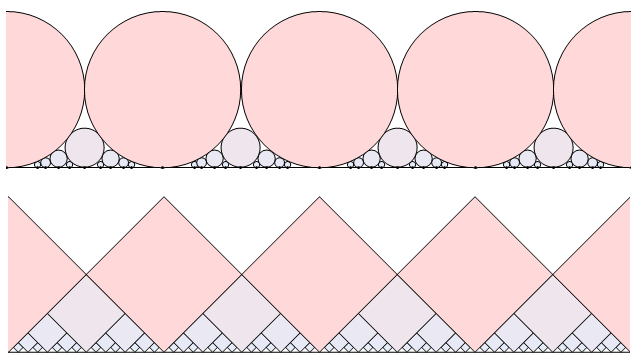
Ford circles and diamonds

There are certain similarities between the rationals and dyadic rationals. The Ford circles (above) are defined by placing a circle of diameter 1/q² on each rational point p/q on the real line. Similarly, we can define the Ford diamonds (not an official term; I’m not sure if one exists) by placing a rotated square of diagonal length 1/2^k on each dyadic rational point p/2^k on the real line.

Applying the Minkowski question mark function to the Ford circles gives a deformed version of the Ford diamonds. Similarly, the inverse Minkowski question mark function should deform the Ford circles into a set of weird shapes positioned on the quadratic surds. Squircles, possibly? I have yet to experiment with this, but I’ll let you know if I find anything interesting.

Posted in Uncategorized | Leave a comment

Activities with golden rhombi

For this post, I’ve decided to do something different. Instead of the usual mathematical monologue, this is a more of a hands-on activity. It is centred around the golden rhombus, which is so named because the ratio of the diagonals is equal to phi. To construct the various examples and projects of your own, you will require the following materials:

  • A4 card, on which to print off a plethora of golden rhombi. You can download both blue and green templates, each of which has 24 identical golden rhombi.
  • Sellotape, as an adhesive.
  • Scissors to cut out the golden rhombi from the A4 card.
  • Plenty of patience, by which I mean the desirable personality trait rather than the solitaire card game.

Project 1: Rhombic triacontahedron

As implied by the name, the rhombic triacontahedron will require 30 rhombi to construct. Start off by placing the acute vertices of five of these rhombi together and Sellotape the edges together. This should form a basic three-dimensional star. Placing another five rhombi in the depressions of this star will give a decagonal dome:
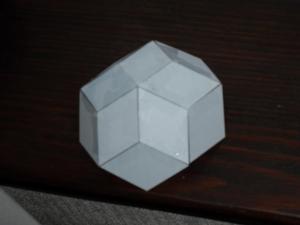
Decagonal dome

Continue extending this dome in the natural way, ensuring that three obtuse angles meet at alternate vertices and five acute angles meet at the other vertices. The completed rhombic triacontahedron should resemble a dome from every angle:
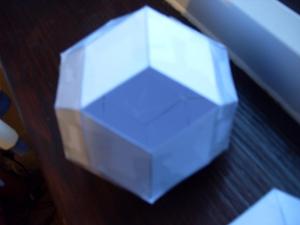
Rhombic triacontahedron, with one face missing

At the penultimate stage, it should look resemble the photograph above. You can then complete your rhombic triacontahedron by attaching the thirtieth and final rhombus. The rhombic triacontahedron (daltlP6) is the dual of the icosidodecahedron, one of the Archimedean solids. You can view the icosidodecahedron and many others in my interactive Wythoffian polyhedron builder.

Project 2: Rhombic hexecontahedron

The rhombic hexecontahedron is twice as expensive as the previous project. You may recognise it as the logo of the computational knowledge engine Wolfram Alpha. It seems that the best way to construct it is to begin with twenty ‘spikes’ of three rhombi each:
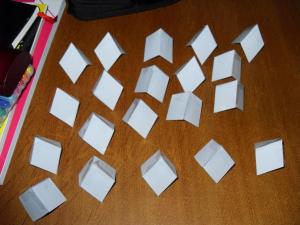
Rhombic spikes

Assemble these in the same way you would build an icosahedron out of triangles. Be careful that there are five spikes around each of the innermost vertices. An almost-completed rhombic hexecontahedron is shown below:
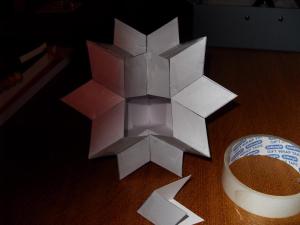
Partially completed rhombic hexecontahedron

As with the previous project, the last component is the most difficult one to attach. It might be best to pre-prepare the spike with Sellotape before adjoining it to the hexecontahedron. Then again, it is probably safest to just apply the tape incrementally, since otherwise yor hexecontahedron may meet a sticky end…

Projects 1 and 2 are compatible. Twelve rhombic triacontahedra can fit comfortably in the depressions of the rhombic hexecontahedron. You could produce a three-dimensional snowflake by further attaching a rhombic hexecontahedron to the end of each of the resulting bulges. I have neither the resources nor the patience to persue this, but I urge you to persuade a team of people to do it.

Project 3: Quasicrystals

With six rhombi, it is possible to make either of two ‘golden parallelepipeds’. The prolate version can be made by affixing two of the ‘spikes’ you made when building the rhombic hexecontahedron. Similarly, the oblate version is composed of two shallow hexagons, each of which comprises three rhombi. Assembly instructions aren’t really necessary for these simple solids.
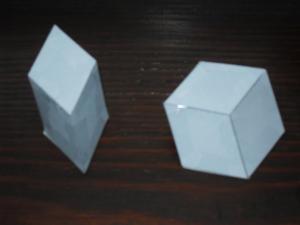
Golden parallelepipeds

They’re really versatile. We can build a more rigid rhombic hexecontahedra out of twenty prolate parallelepipeds, or a rhombic triacontahedron using ten of each. This page explains how to construct the latter. These structures are prevalent in three-dimensional icosahedral quasicrystals of aluminium-lithium-copper. The mathematical model, the Ammann-Kramer tiling, is a three-dimensional analogue of the Penrose tiling. Indeed, my initial idea of making these rhombic polyhedra out of card was to explore the Ammann-Kramer tiling.

Project 4: Wieringa roofs

A Wieringa roof is a Penrose tiling with raised vertices, such that all of the rhombi are congruent. You can explore and rotate them in my other demonstration. The obvious method is to construct these things tile-by-tile with Sellotape. This is okay if you have a template to work with, such as my demonstration. You can quite easily get carried away adding extra rhombi; I managed to exercise constraint and limit myself to the following:
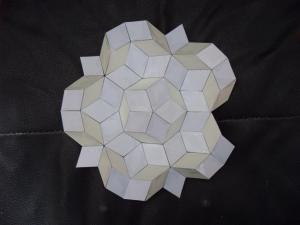
Wieringa roof

Actually, as you can see, I ran out of green rhombi. There are twenty-four rhombi on each sheet, whereas I needed twenty-five for the depth-3 iteration of the Wieringa roof. You may notice overlapping decagons in the image. There are two types, namely the ‘sun’ in the middle and the five (well, four complete ones) flanking it. As Petra Gummelt discovered, we can construct a Penrose tiling by overlapping these decagons. Unlike in the Sellotape method, you won’t have to restart if you make a mistake; you can simply rearrange the decagons.

Project 5: Reptiles

This word usually refers to a certain class of chordates such as turtles and snakes, but here is actually a portmanteau of ‘replicating’ and ’tiles’. The parallelepipeds are ‘unit cells’ which can be made into larger similar parallelepipeds if you have n³ of them. Hence, anything we make using parallelepipeds (such as the rhombic hexecontahedron) can be made in larger sizes. Rather than include an actual cardboard model, I’ve returned to my lazy ways and used Mathematica to generate one:
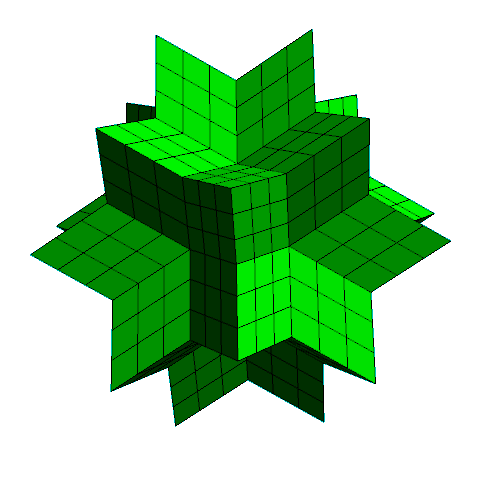
Reptile hexecontahedron

Like many reptiles, it is a pleasant shade of moss-green. Of course, taking the reptile analogy too literally, you could conceivably create a crocodile from the ‘spikes’ used in the construction of the rhombic hexecontahedron.

Be creative

Rather than merely adhere to the blue and green templates I have included, you could print them out on the reverse of some lovely metallic silver card from Paper Chase (unlike the BBC, there are no issues with product placement on Complex Projective 4-Space). Don’t refrain from decorating your rhombi with sequins; to further incorporate the golden ratio, you could use Fibonacci sequins!

Please send in photographs of your constructions. Only provide copies, as we are not able to return originals. If you send in enough of your creations, I should be able to compile a video of them to the tune of Left Bank Two (thanks go to Tom Rychlik for wasting many hours of his life trawling through YouTube comments to ascertain the name of the tune, as he revealed whilst we were eating Crispy Creme doughnuts — the simply connected British variety, not those toroidal American doughnuts). Please include your forename so that we can attribute your artwork to you.
Posted in Activities | Leave a comment

Sexy symmetrical starfish

Studies have shown that bilateral symmetry in female humans is linked to attractiveness. Also connected with attractiveness is the presence of the golden ratio (the positive real root of the quadratic equation x² – x – 1 = 0, approximately 1.618034). Earlier, we saw how it determines the arrangement of primordia in a Helianthus sunflower. It is far more ubiquitous than that, occurring in the proportions of the Parthenon, the position of the naval and, thanks to recent research by a Belgian gynaecologist, the dimensions of the uterus.

One must be careful to avoid seeing phi where it doesn’t actually exist. It’s very easy to read too much into a set of data, and there are (probably justified) claims that the Belgian gynaecologist did just that. However, certain mathematical objects undeniably feature the golden ratio. A regular pentagon is one of those — the ratio between the length of a diagonal and the side length is equal to phi.

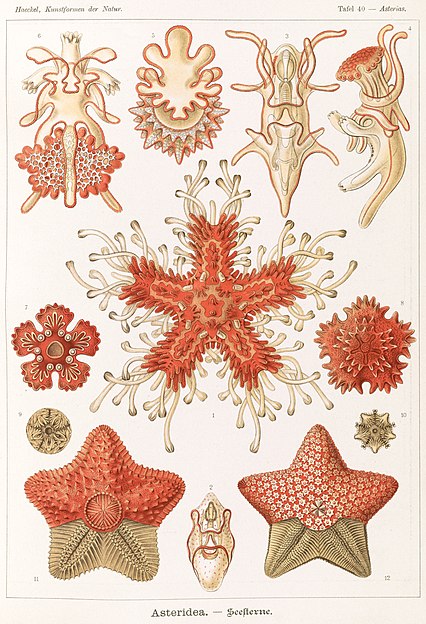
Obviously these are necessary, but by no means sufficient, conditions for attractiveness: starfish intrinsically incorporate the golden ratio and display five axes of bilateral symmetry, but we do not find them attractive (at least I don’t, and I hope the same applies to you). A sufficiently-old-to-be-copyright-free drawing of these echinoderms is given below:

Echinoderms, some of which have pentagonal symmetry

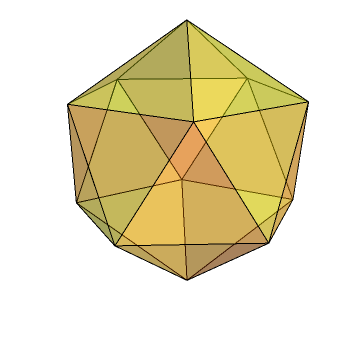
Nevertheless, we can do better than that. There are amoeboids called Radiolaria, some of which have icosahedral symmetry. So do, in fact, viruses such as the common cold. The symmetry enables the viruses to be specified by a short description: a single gene can code for 60 identical proteins forming the shell of the virus. A regular icosahedron has six axes of pentagonal symmetry.

Icosahedron

An icosahedron has a rotation group of order 60, so can be split into 60 congruent pieces. By specifying just one of these identical pieces, a virus can encode its shell in an impressively compact sequence of DNA.

If, like the inhabitants of Edwin Abbott’s Flatland, there is a spatial dimension beyond our own, then there may be organisms with hyper-icosahedral symmetry. In four dimensions, there are regular polychora called the 120-cell and 600-cell, which are four-dimensional analogues of the dodecahedron and icosahedron, respectively. There is even such a sadistic puzzle as a Rubik’s 120-cell, which so far has only been solved by six people. Beyond four dimensions, however, there are no further interesting regular polytopes; only simplexes, hypercubes and their duals exist in five or more dimensions.

Posted in Uncategorized | Leave a comment

Elliptic curve calculator

What’s the cheapest calculator you know of? Basic calculators are much cheaper than their scientific counterparts, and you can probably get one for £2. A slide rule is even cheaper: you could strap together two plastic rulers with logarithmic scales for about 20p — a saving of an order of magnitude. Pretty impressive for a couple of sliding scales.

We can do much better than this, though. You can print a fully functional calculator, capable of multiplication, division and extraction of square roots, on a single sheet of A4 (or A3 for ‘double precision’!) paper. This is probably an order of magnitude again cheaper than a regular slide rule, costing about 2 pence.

Elliptic Curve Calculator

A sheet of paper capable of multiplication, division and square root computation, with similar precision to a slide rule but for one tenth of the price.

Clicking the above image will link to a full-size version, which you can print off and use. Note that it has two scales, red and blue, running in opposite directions on an elliptic (non-singular cubic) curve. The scales are reciprocals of each other; for any point labelled x in red and y in blue, xy = 1.

To multiply two numbers together, find them (ignoring decimal places; 10x and x are represented by the same point) in the same colour and draw a straight line through them. This will intersect the elliptic curve in a third point. Read the result off on the oppositely-coloured scale; this is the product of the two numbers!

Multiplication with the Elliptic Curve Calculator

Find two numbers (a and b) in the same colour (blue), and project a line through them to meet the curve in a third point. Read this off in the opposite colour (red) to obtain the product, ab.

Similarly, you can divide and compute square-roots, as shown in the pictorial instructions at the foot of the image. It’s very simple to use, but to explain why it works is much more difficult; it relies on some advanced algebraic geometry and group theory typically encountered in degree-level mathematics. If you really want to know why, continue reading. But be warned: the mathematics gets quite complicated.

It all boils down to the fact that the points on an elliptic curve form an Abelian group. This has a similar structure to the real numbers, which means that we can interchange between the two. (This is not so straightforward, requiring a transcendental function related to the Weierstrass P-function. I used repeated interval bisection and polynomial interpolation to obtain a good approximation instead.)

We define an operation on the points of the elliptic curve. We’ll represent this with a funky symbol such as @. For three collinear points on the curve, A, B and C, we say that A @ B @ C = e, where e is the identity element. It’s pretty obvious that B @ A @ C = e, as well, since the order of points on the line is unimportant. In other words, A @ B = B @ A — the group operation is commutative. It suffices only to show that A @ (B @ C) = (A @ B) @ C — associativity — before we can treat @ like addition or multiplication, which are themselves equivalent due to the exponential function. Proving associativity is possible with a lovely theorem called Cayley-Bacharach.

In my elliptic curve calculator, I have used @ to emulate multiplication. Division is rather routine, since it’s just reverse-engineering multiplication. Finding the point B with a tangent intersecting the curve at A is equivalent to solving A @ B @ B = e, so B is the square root of the reciprocal of A.

The geometry of elliptic curves has applications in advanced cryptography, where it offers superior security compared with ordinary RSA (Rivest-Shamir-Adleman). It’s very easy with repeated squaring to quickly compute the nth power (B = A @ A @ … @ A) of a point A on the curve. However, given A and B, it is very difficult to reverse-engineer the process to obtain n. This is known as the discrete logarithm problem. With some effort, it can be adapted into a cryptosystem similar to RSA, but in the setting of elliptic curves instead of modular arithmetic.

Elliptic curves were also the tools used by Andrew Wiles to prove (most of) the Tanayama-Shimura Conjecture and thus Fermat’s Last Theorem. The simplest proof of Poncelet’s porism also involves elliptic curves.

Posted in Uncategorized | 16 Comments

Cipher 1: Puzzle Hybridisation

This is the first of a series of cipher challenges published at regular intervals. After much deliberation, I settled upon a 28-day cycle, for the benefit of both werewolves and pre-menopausal women alike. It is also a convenient multiple of the seven-day week invented by the Mesopotamians (yes, I know what you’re thinking: they usually adopt a sexagesimal system for time, money, distance etc.). Henceforth, the Tuesday immediately prior to the full moon shall be termed Cipher Tuesday.

Strictly speaking, the lunar month is inevitably slightly different from 28 days, so Cipher Tuesday will eventually become out of phase (no pun intended) with the Moon. I’ll be writing a post on lunisolar calendars, continued fractions and the LLL lattice reduction algorithm in the foreseeable future, but until then this crude approximation will suffice.

Anyway, the puzzle. I wrote a message of 336 characters, enciphered it and wrote it on a completed 336-piece jigsaw. I then proceeded to disassemble the jigsaw and randomly rearrange the pieces. Actually, I told Wolfram Mathematica to do the same; it has much more patience than I do. The result is a two-stage puzzle, the Jigcypher. There is a reason for the archaic British spelling, but I prefer not to divulge it at this stage.

Clicking on the above image will link to a full-size PNG of the Jigcypher. You could print it off on A4 card for a more tactile version; being the order of PGL(2,7), 336 has many factors so there are plenty of ways to evenly partition the pieces into sheets of equal size. Six sheets of 56 pieces should work nicely. Alternatively, you could assemble the entire jigsaw in MS Paint or some other graphics program. I’ve used lossless compression (PNG) to retain the perfectly solid white background for this purpose. The pieces are all in the correct orientation, as you can discern from the Greek letters on the (non-empty) tiles.

I have nothing more to say on this topic, apart from a terrible cryptanalysis-based pun: ‘Get cracking!’

Posted in Ciphers | Leave a comment

Conway polyhedron notation

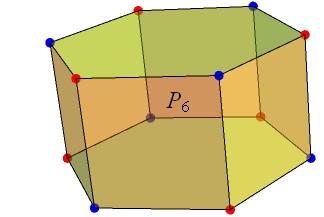
There is a plethora of polyhedra. One way to classify polyhedra is based on their symmetry, transitivity and other properties. An alternative, constructive approach, by John Conway, involves specifying sequences of operations to turn one polyhedron into another. Quite a good starting point is the hexagonal prism:

A hexagonal prism, with alternate vertices coloured red and blue.

A hexagonal prism, with alternate vertices coloured red and blue.

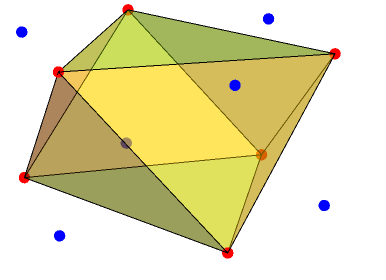
There are many operations we can apply. For this post, it suffices to consider only four: alternation, truncation, rectification and duality. We’ll begin with alternation. We 2-colour the vertices red and blue and discard all of the blue vertices. When applied to our hexagonal prism, we obtain the octahedron:

The octahedron with Conway notation lP6

The octahedron with Conway notation lP6

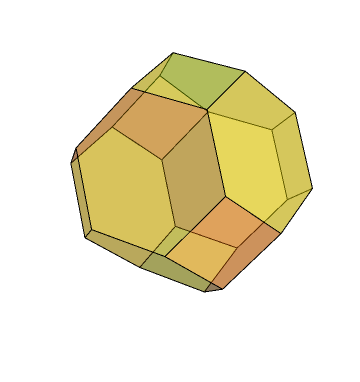
This is represented ‘lP6’, as we use ‘l’ for alternation and the original solid was the hexagonal prism, P6. We’ll now truncate it using the operator ‘t’ to obtain the truncated octahedron. This is one of the more interesting Archimedean solids, being able to tile three-dimensional space.

A truncated octahedron, tlP6

Pretty impressive, huh? Well, things are going to take a turn for the unexpected when we alternate it. See if you can guess what ltlP6 is. You should be very surprised by this. Amazed, even. Prepare for a shock unseen in your wildest dreams.

Icosahedron

Yes, it’s an actual icosahedron.

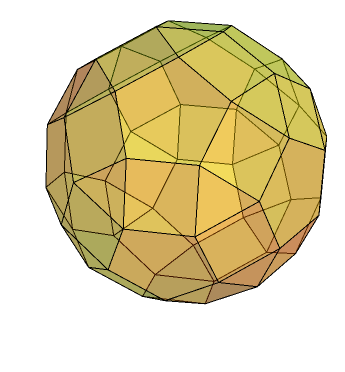
There’s a very good reason why this occurs, although the transition from octahedral to icosahedral symmetry is quite unusual. We can then apply two rounds of ‘a’ (rectification, which is an extreme version of truncation where none of the original edges remain) to obtain that most sesquipedalian of solids, the small rhombicosidodecahedron.

Rhombicosidodecahedron, aaltlP6

Rhombicosidodecahedron, aaltlP6

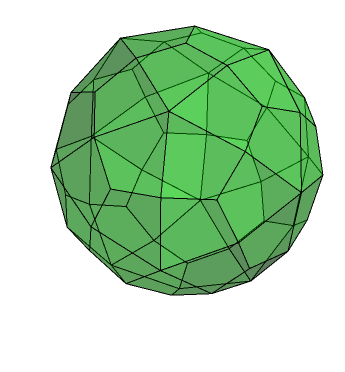
This is an Archimedean solid. We can then take its dual, which is a Catalan solid called the deltoidal hexecontahedron. The transition from a uniform polyhedron to a non-uniform one is signalled by the colour change:

Deltoidal hexecontahedron, daaltlP6

Deltoidal hexecontahedron, daaltlP6

The duals of Archimedean solids are commonly known as Catalan polyhedra. We can get any Platonic, Archimedean or Catalan polyhedron by starting with the hexagonal prism and applying some combination of those four operations. If you include other operations such as stellation, you can obtain spiky solids like the one knitted by Katie Steckles and mentioned in my previous post. Joseph Myers also has an extensive collection of hand-made cardboard polyhedra of various types.

No polyhedra were harmed in the making of this post. If you are concerned about the welfare of polyhedra, consult your local psychiatrist.

Posted in Uncategorized | 6 Comments

Are you Ready?

I expect you’re tired of hearing about the centenary of Alan Turing’s birth. His automated machines for cracking the German Enigma and Lorenz ciphers have enjoyed quite a lot of recent press, as has his pioneering work on the theory of computation. Without Turing, we would have bizarre, inefficient machines based on lambda calculus.

You’ve probably also heard the tragic story of how the British legal system condemned him to the mental torture of hormonal therapy. It is almost universally acknowledged that his death, involving a cyanide-immersed fruit of the genus Malus, was suicide. That’s right: a bunch of ungrateful ne’er-do-wells in Parliament decided that Turing’s unparalleled contributions to the war effort were no mitigation for his unconventional sexuality.

But what happened in his final years? It transpires that much of his research was in the field of mathematical biology, specifically in comprehending the cornucopia of patterns found in nature. For example, the phyllotaxis (arrangement of seeds, or ‘primordia’) in the common sunflower (Helianthus annuus) can be described by a startlingly simple formula.

Image

The formula gives a set of complex numbers, which, when plotted on the Argand plane, results in the pattern above. The points lie on a spiral known as the Fermat spiral.

Image

Other patterns have more complicated mathematical descriptions. Turing found that Friesian cow patches and so forth can be modelled by a reaction-diffusion system, a partial differential equation designed to emulate chemical reactions. They can be regarded as a continuous (or, indeed, analogue!) analogue of cellular automata. Now, some really cool guys have developed software to explore these systems. Katie Steckles published an entry over at The Aperiodical: http://aperiodical.com/2012/07/ready-reaction-diffusion-simulator/

One of the cuter aspects of Ready (by analogy with Golly, its lightning-fast and more conventional cousin, which is an extension of the acronym ‘GoL’ meaning ‘Game of Life’, but that’s enough etymology for today) is the ability to emulate these systems on arbitrary meshes (or tessellations of 2-dimensional manifolds, if you’re a mathematician). For example, we can actually watch the emergence of zebra stripes on an actual … well, a horse, actually, but never mind! In a similar vein, here are Turing’s leopard spots on a rather ferocious lion:

Image

Tim Hutton (lead developer of Ready, and fellow resident of Derbyshire) is even adding support for three-dimensional tessellations of space, such as the face-centred cubic lattice of rhombic dodecahedra, the body-centred cubic lattice of truncated octahedra, and the Voronoi diagram of atoms in a diamond. You can read about all of this stuff in the Symmetries of Things, by John Conway, Heidi Burgiel and Chaim Goodman-Strauss. Anyhow, this nicely leads on to the next topic I wanted to discuss: the Poincare disc model of hyperbolic space. In layman’s terms, hyperbolic space is curved in the opposite way to a sphere. I’ll not go into the mathematics here, as I’ve already done so in my forthcoming book, Mathematical Olympiad Dark Arts. Can’t wait now, can you?

Anyway, as much as I enjoy promoting my own work, I seem to be digressing somewhat. The important thing is that Tim Hutton and I have been exploring reaction-diffusion systems on the Poincare disc in Ready. This seemed like a logical extension, since we’ve already experimented in the Euclidean plane and on the surface of a sphere.

Image

We can do better than Poincare, though. Embedding a curved surface on a flat plane is bound to create problems, which is why Greenland looks larger than South America on maps using the Mercator projection. A variant of a map which avoids distortion is a really revolutionary (no pun intended) three-dimensional visualisation of the Earth: a globe. Similarly, it is possible to use our third dimension to embed the hyperbolic plane without distortion. There are two approaches I know of:

  1. Sellotape lots of identical regular heptagons of paper together. I did have a model of this with twenty-four heptagons, but then I ruined it by trying to fold it into a bizarre three-holed torus called a Klein quartic. Warning: do not try making a Klein quartic at home! Just read about it on the Internet or in my book.
  2. Invoke the ancient art of crochet. This was mentioned on Tim Hutton’s blog and in the award-winning book Crocheting Adventures with Hyperbolic Planes. The award that the book won, by the way, was that for the weirdest book title!

People have crocheted coral reefs using hyperbolic geometry. There’s a massive one in the Smithsonian Museum, for example: http://www.mnh.si.edu/exhibits/hreef/. The aforementioned Katie Steckles seems to have got the wrong idea, since she ended up knitting a surface with overall positive curvature (http://aperiodical.com/2012/08/knitted-spiky-icosahedron/). Oops!

However, I am again deviating from the subject, which is the computer program Ready. It received a huge boost of popularity recently due to me (sorry, more self-promotion!) and my glider in a cellular automaton on a Penrose tiling. It was quite amusing that such a small construction won me $100 (thanks, Andrew!) and mentions in the New Scientist and the Aperiodical.

The original rhombus tiling glider was quite boring, travelling in straight (well, slightly wiggly) ribbons. However, Andrew (Trevorrow) and I have investigated the same glider on Penrose’s slightly more familiar tiling of kites and darts. This time, the glider orbits in loops of varying sizes in addition to unbounded fractal paths. The neat thing is that all of the loops have either pentagonal or approximate decagonal symmetry. A few of them are shown below:

Image

For further details, see the paper I’ve just submitted to the Journal of Cellular Automata. (Thrice in one post? Wow, I’m really good at self-promotion! Wait — was that a fourth time? Damn you, self-referential statements!)

Posted in Uncategorized | Leave a comment

Pathological functions

For my first post on this blog, I’ve decided to stay away from complex projective 4-space, but instead write about something equally mathematical and just as interesting: pathological functions. The ideas may be more familiar to you in the form of fractals, although the definitions are different and not equivalent: a pathological function is a function from the real numbers to the real numbers, whereas a fractal curve is a subset of the plane. I’ll be discussing fractal curves more in later posts.

The ‘blancmange function’ is a famous example of a pathological function, which is everywhere continuous but nowhere differentiable. It is defined by successively summing triangle waves of exponentially decreasing size together.

Blancmange function

Successive approximations to the blancmange function formed by adding triangle waves together

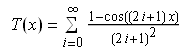
In the same way that the blancmange function is expressed as an infinite series of triangle waves, a single triangle wave can be expressed as a sum of cosine waves (and constant terms, which can be regarded as cosine waves of infinite period), known as a Fourier series. These are named after a Mr. Fourier, who realised that the sounds produced by musical instruments can be expressed as Fourier series, and by induction an entire orchestra. The triangle wave, for example, is given by the following Fourier series:

Fourier series of the triangle wave

Fourier series of the triangle wave

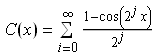
If we just take the first term of this Fourier series, and add them together as in the blancmange function, we obtain a simpler pathological function. To continue the tradition of naming pathological functions after desserts, and in honour of Trinity College, where the dessert was conceived, I have entitled this the ‘creme brulee function’. It also has a simple Fourier series:

Fourier series of the creme brulee function

Fourier series of the creme brulee function

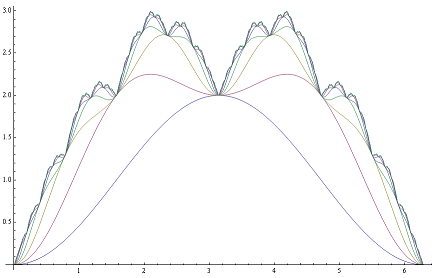
It is also everywhere continuous and nowhere differentiable, like my hairstyle and the blancmange function, and greatly resembles the latter. The successive approximations are more curvaceous and aesthetically pleasing than the jagged edges of the sawtooth function.

Successive approximations of the creme brulee function

Successive approximations of the creme brulee function

The original blancmange function can easily be expressed as an infinite sum of creme brulee functions. I’ve done it, but to save uploading another formula, I’ll leave this as an exercise to the reader. This infinite series should suggest why the creme brulee function and blancmange function differ only slightly: the second term is nine times smaller than the first term, and subsequent terms are even more negligible.

Posted in Uncategorized | Leave a comment